Supplementary
schooling
Register for Social Emotional Learning
Welcome! Register to access the Social Emotional Learning platform.
What is SEL?
Social emotional learning (SEL) is a process through which
individuals acquire and effectively use knowledge, qualifications,
attitude and skills necessary for dealing with day-to-day challenges in
order to develop into inquisitive people, able to understand their
emotions and those of others. It also enables people to have positive
interactions with others, to act from internal motivation, to exhibit
flexible thinking and to develop the abilities to persist, to regulate
emotions and behaviour, and to make decisions responsibly. In
recent years, there has been a dramatic rise in both research and
practice of social emotional learning. During the past four years alone
half a million SEL-related scientific studies were published. In this
massive amount of literature there have been different areas of
emphasis, and a variety of definitions and points of view.
What is SEL?
Social emotional learning (SEL) is a process through which individuals acquire and effectively use knowledge, qualifications,
attitude and skills necessary for dealing with day-to-day challenges in order to develop into inquisitive people, able to understand their emotions and those of others. It also enables people to have positive interactions with others, to act from internal motivation, to exhibit flexible thinking and to develop the abilities to persist, to regulate emotions and behaviour, and to make decisions responsibly. In recent years, there has been a dramatic rise in both research and practice of social emotional learning. During the past four years alone half a million SEL-related scientific studies were published. In this massive amount of literature there have been different areas of emphasis, and a variety of definitions and points of view.
SEL Competencies
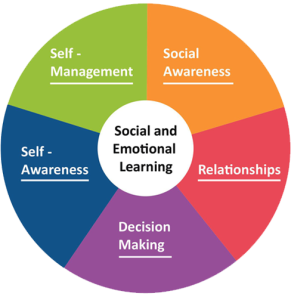
SEL competencies are the abilities to coordinate cognitive, emotional and behavioural processes in order to encourage optimal development, enable achievement of goals, and be successful in a variety of relationships and cultural environments. The CASEL model relates to these competencies as belonging to five main areas, including intrapersonal skills, attitudes and abilities (self-awareness), interpersonal abilities (self-management, social awareness, relationship skills) and responsible and ethical decision making in personal and social situations (responsible decision making).